

Reviewed · ANCIENT TOWN WALKING TOURS
Luxury Half-Day Tour of Hoi An Ancient Town
Four hours in Hoi An feels surprisingly big. This luxury half-day tour turns the old town lanes into a walkable story, starting with hotel pickup around 08:00 and ending back at 11:00 with time to browse. I especially like the combo of temples plus standout merchant architecture (hello, Tan Ky Ancient House), and I like how the guide keeps the town personal, with context you can actually use while you wander.
One thing to consider: you’ll be moving through narrow lanes and there’s a strict no-luggage rule, so plan on comfortable shoes and packing light. Also note there’s a mismatch in the info (it says wheelchair accessible, yet also lists not suitable for people with mobility impairments), so you’ll want to check before booking if mobility is a concern.
In This Review
- Key highlights worth penciling in
- Hoi An in a half-day: what you’re really buying for $55
- From hotel lobby to old town lanes: the 08:00 start that sets the pace
- Temple Kwan and Phuc Kien: where the town’s Chinese roots become visible
- Tan Ky Ancient House: a merchant home you can read, not just admire
- Japanese Covered Bridge and cultural show rooms: the crossroad section
- Fish market time: everyday life between monuments
- Old Town shopping with a guide: what to buy and how not to get lost
- Included extras that make the tour smoother (bicycle, helmet, and fees)
- Price and value: why $55 can feel fair in Hoi An
- Who this tour suits best (and who should double-check)
- Should you book this half-day Hoi An tour?
- FAQ
- What time does the tour start?
- How long is the tour?
- Where does the tour pick up and drop off?
- What’s included in the price?
- What isn’t included?
- Do I need to buy entrance tickets?
- What language is the guide?
- What should I bring?
- Is luggage allowed?
Key highlights worth penciling in
- Temple Kwan + Phuc Kien stops that explain the Chinese influence you’ll see all over town
- Tan Ky Ancient House to see how a merchant home was designed for trade and family life
- Japanese Bridge and nearby cultural show rooms for a clear look at Hoi An’s cross-cultural layout
- Old Town orientation on foot so you know where you are before you shop
- An English guide who helps with questions and shopping, with guide names like Huy, Tea, and Minh showing up in past experiences
Hoi An in a half-day: what you’re really buying for $55

This tour is priced at $55 per person for a half-day, which is the first reason to pay attention to the fine print. You’re not just paying for someone to point at buildings. You’re paying for pickup and drop-off, an English-speaking guide, entrance fees, and even a bicycle and helmet as part of the experience. That matters in Hoi An, because the old town is built for wandering, not for figuring things out from scratch.
You’re also buying time. If this is your first morning in Hoi An, you’ll get your bearings fast—where the main historic pockets are, which lanes connect, and what to look for so you don’t miss the best details while you’re still catching your breath.
The “luxury” part here is mostly about comfort and structure: hotel pickup, a guide who stays with you, and no need to manage tickets on your own. It’s not a resort-style experience. It’s a well-paced guided walk with curated stops in the Ancient Town area.
Deeper into the yellow-walled lanes on foot
- Hoi An: Ancient Town Guided Walking Tour★ 4.9 · 766 reviews
- Hoi An Ancient Town Walking Tour with a Local★ 5.0 · 517 reviews
- The Lantern Lady: Traditional Lantern Class in Old Town★ 4.9 · 444 reviews
- Hoi An Ancient Town – Walking Tour with Local Guide★ 4.9 · 385 reviews
From hotel lobby to old town lanes: the 08:00 start that sets the pace
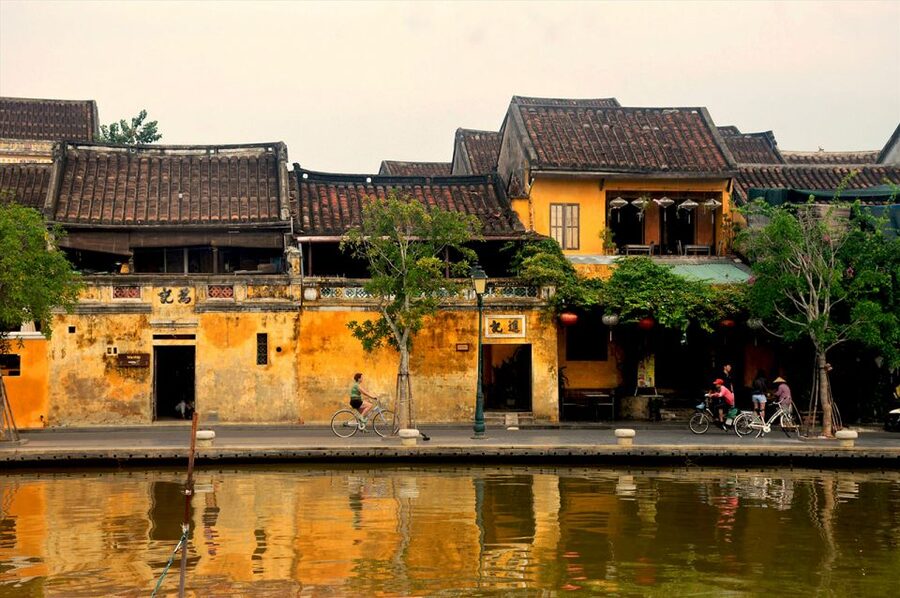
Your day kicks off at 08:00, when the guide welcomes you at your hotel lobby. You’re expected to be ready about 15 minutes early, and then you head toward the old town on foot. Once you’re there, you buy entrance tickets and start touring.
That early start is practical. Old Town lanes can get crowded later, and once you’re shoulder-to-shoulder with other groups, it’s harder to read details—like carved doorways, weathered roof lines, and the blend of architectural styles you’ll notice everywhere. Starting in the morning also gives you a smoother transition into the shopping time after the tour.
There’s one constraint that can affect your comfort: no luggage or large bags are allowed. If you’re traveling with a big backpack, this is the moment to plan storage at your hotel so you’re hands-free while walking.
Temple Kwan and Phuc Kien: where the town’s Chinese roots become visible
A big part of why Hoi An feels special is that it’s not one culture laid over time. It’s a mix, and you see it in religious spaces as much as in buildings. The tour includes Temple Kwan and the Phuc Kien Temple (often connected with Phuc Kien Assembly Hall areas), both tied to Chinese heritage in Hoi An.
What you’ll get from these stops isn’t just the location of a temple. It’s the way the architecture and layout help you understand how people lived and worshiped when merchants and communities were forming along the Thu Bon River trade routes. You’ll also be in the right mindset to spot Chinese design cues elsewhere once you leave—like the symmetry, decorative elements, and the sense of purpose in how structures face inward.
Practical tip for you: take a moment to slow down at each temple. The lanes here are narrow, and it’s easy to move past key details too fast. A guide helps, but your best photos and your best impressions come from pausing for a breath.
Tan Ky Ancient House: a merchant home you can read, not just admire
Next comes Tan Ky Ancient House, one of the stops that makes this tour feel worth it even if you’ve seen other “old house” experiences. A guided visit changes the game here because a merchant home isn’t just pretty. It’s functional.
In a place like Hoi An, the old houses reflect practical needs tied to trade and family life. You can look for the way rooms connect, how the building handles light and ventilation, and how the layout supports daily life. With a guide in your ear, you’ll understand more of the why behind the design instead of only admiring the what.
This is also a great stop for your future self. After seeing Tan Ky, you’ll start recognizing how different houses in the Old Town are built and why they look the way they do. You’ll walk past other historic homes and think, Oh, that’s the same logic.
A few more Hoi An trips worth weighing before you book:


Japanese Covered Bridge and cultural show rooms: the crossroad section
Hoi An’s Japanese Covered Bridge is one of those landmarks that people photograph constantly—but a guided stop helps you notice what’s around it. The tour includes the bridge plus cultural show rooms, which give context for the town’s history of international contact.
The key value here is orientation. Many visitors see the bridge and move on. You’ll also look at the broader area where the town’s international identity shows up in the layout—because Hoi An isn’t just one “old vibe.” It’s a set of neighborhoods shaped by different influences, including Chinese, Japanese, French, and European styles that you’ll keep spotting in the lanes.
If you like culture that feels connected to everyday streets (not separated into a museum box), this part is for you. You’ll understand that the bridge is one visible symbol of a much bigger network of connections.
Fish market time: everyday life between monuments
One of the more charming parts of this tour is that it doesn’t stay entirely on postcard scenery. It includes a stop at a local fish market.
This matters because markets in Vietnam aren’t staged. Even when you’re not buying anything, you’re seeing real movement, real smells, and real rhythms. It’s a reminder that Hoi An’s historic buildings are still part of a living town, not a theme park.
The practical drawback: if you’re sensitive to strong smells or you don’t like busy, active spaces, you might want to keep your pace steady and avoid lingering too long. But if you can handle a bit of reality, this stop gives your photos a “real day in Hoi An” feeling that pure sightseeing can’t match.
Old Town shopping with a guide: what to buy and how not to get lost
After the main walking tour, you’ll have free time to shop in the Old Town, and the guide takes you back to your hotel at 11:00.
This is where the tour pays off for me, because shopping without a plan can turn into aimless wandering. With a guide, you can ask what’s worth looking at and what to skip. Past experiences highlight that guides like Tea and Minh are good at helping people with shopping, including pointing you toward what fits what you want.
You’ll find plenty of crafts and souvenirs, but here’s the smart way to shop on a short schedule:
- Start by browsing first, not buying immediately.
- Use your time to find one or two items you really want, not ten half-decisions.
- Keep an eye on quality in details: stitching, wood finishing, and how items are put together.
Since the tour is only half-day, you don’t need to turn shopping into a full marathon. You just need enough time to pick the good stuff while your bearings are still fresh from the tour.
Included extras that make the tour smoother (bicycle, helmet, and fees)

Even though the itinerary reads like a walking plan, the inclusions tell you this isn’t an ultra-budget group hike.
You get:
- Hotel pickup and drop-off
- Bicycle + helmet
- All entrance fees
- An English-speaking guide
- Tax & services charge
- Travel insurance
The entrance fees and guide are big value pieces. In old towns, you can burn time trying to locate ticket counters, figure out which sites require entry, and then backtrack. Here, you start with the plan already in motion.
About the bicycle: the details aren’t spelled out beyond “bicycle, helmet” being included, but you should expect that part of your movement is supported by it. It’s a nice option when lanes are tight or when you’d rather conserve energy for the key stops.
And yes—remember the no large bags rule. It’s easy to forget when you’re excited and start stashing things in your backpack. Keep it simple.
Price and value: why $55 can feel fair in Hoi An
Let’s talk money in a straightforward way. $55 per person sounds like a bargain or a lot, depending on what’s included. Here, it’s more than a guide. Your cost covers:
- Pickup/drop-off from centrally located hotels (with the reminder to arrange pickup from your hotel or nearby location when confirming)
- Guide time in English
- Entrance fees for the stops included
- A bicycle and helmet
- Travel insurance
- Taxes and service charges
What’s not included also matters:
- Beverages and other meals not mentioned
- Vietnam visa fees
- Early check-in and late check-out
- Personal expenses like laundry and shopping
- Single supplement (so if you’re traveling solo and need single occupancy, that could change the real cost)
- Extra costs caused by disruptions like typhoons, flight delays, medical evacuations, and the like
So the real question for you is: do you want your time in Hoi An handled for you, at least for the first half day? If yes, then the price starts to make sense. If you’d rather go at your own pace with zero structure, you might find cheaper options elsewhere—but you’ll be taking on the ticket and navigation work.
Who this tour suits best (and who should double-check)
This is a good fit if you:
- Want a first-day orientation in Hoi An Ancient Town
- Like guided context for temples and old homes
- Prefer a structured half-day with a clear start and end time
- Plan to do shopping after you tour, not before
- Appreciate English guidance
Based on guide experiences shared in the past, the best results happen when you ask questions. Guides such as Huy have been praised for being proud and for teaching people a lot about Hoi An and Vietnam. Tea has been praised for being very informative and for helping with shopping. Minh has been praised for local insights and respectful storytelling about family and country life.
One more suitability note: the activity info says wheelchair accessible, but it also says not suitable for people with mobility impairments. That conflict means you should confirm details directly with the provider before you book, especially if you use a wheelchair or need special assistance.
Should you book this half-day Hoi An tour?
If this is your first time in Hoi An, I think you should seriously consider booking it. You get the right mix: Temple Kwan and Phuc Kien, Tan Ky Ancient House, the Japanese Covered Bridge, a fish market stop, and then Old Town shopping time—wrapped into a tight half-day schedule with pickup and drop-off. It’s a smart way to learn how to look at the town, not just how to pass through it.
Book it if you want help reading the place: the architectural influences, the meaning behind stops, and the practical flow of where to go next. Skip it if you already know exactly what you want to see and you’d rather spend your morning wandering completely solo, with no guides, no included entrances, and no structured route.
If you do book, go in with one simple mindset: wear good shoes, bring a light pack, and ask your guide one or two questions per stop. That’s where the whole experience starts to click.
FAQ
What time does the tour start?
The guide welcomes you at 08:00 at your hotel lobby.
How long is the tour?
It’s listed as 4 hours. The schedule says the start time can vary, so check availability for exact timing, and the tour returns you around 11:00.
Where does the tour pick up and drop off?
Pickup is from your hotel. The activity ends back at the meeting point.
What’s included in the price?
The tour includes hotel pickup and drop-off, bicycle and helmet, all entrance fees, an English-speaking guide, tax and services, and travel insurance.
What isn’t included?
Not included are beverages and other meals not mentioned in the program, Vietnam visa fees, early check-in/late check-out, and personal expenses like shopping.
Do I need to buy entrance tickets?
Yes, your guide will help you buy entrance tickets at the start of the touring portion.
What language is the guide?
The live guide is English.
What should I bring?
Bring comfortable shoes.
Is luggage allowed?
No. Luggage or large bags are not allowed.
More Tours in Hoi An
- From Hoi An: Market Tour, Basket Boat Ride and Cooking Class
★ 4.8 · 2,208 reviews - Hoi An: Basket Boat with Lantern-Making & Cooking Class Tour
★ 4.9 · 1,444 reviews - Coconut Jungle Eco & Hoi An City Tour With Boat Ride
★ 5.0 · 800 reviews - Hoi An: Ancient Town Guided Walking Tour
★ 4.9 · 766 reviews - Hai Van Pass Motorbike Private Tour with Mister T Easy Rider
★ 5.0 · 742 reviews - Hoi An Countryside: Guided Morning or Afternoon Bicycle Tour
★ 4.9 · 686 reviews
More Tour Reviews in Hoi An
- Hoi An: Basket Boat Ride in the Coconut Forest
★ 4.9 · 4,956 reviews - Hoi An: Vietnamese Coffee Culture and Coffee Making Class
★ 4.9 · 4,006 reviews - Hoi An: Vietnamese Foldable Lantern Making Class
★ 4.9 · 3,742 reviews - Cooking Class Hoi An:Local Market, Basket Boat, Fishing & Cooking
★ 5.0 · 3,660 reviews - Hoi An Cooking Class(Market,BasketBoat Crabfishing&Cooking Class)
★ 5.0 · 3,386 reviews - Hoi An: My Son Sanctuary Early Morning w. Champa Food Brunch
★ 4.9 · 2,750 reviews
The Ancient Town on Foot, Continued
- Hoi An: Ancient Town Guided Walking Tour
★ 4.9 · 766 reviews - Hoi An Ancient Town Walking Tour with a Local
★ 5.0 · 517 reviews - The Lantern Lady: Traditional Lantern Class in Old Town
★ 4.9 · 444 reviews - Hoi An Ancient Town – Walking Tour with Local Guide
★ 4.9 · 385 reviews - Hoi An Street Food Walking Tour with Tastings
★ 5.0 · 317 reviews - Hoi An Walking Tour
★ 5.0 · 269 reviews
Just Reviewed: Fresh Hoi An Trips






Ancient Town Walking Tours, compared.
 ★ 4.9Ancient Town Guided Walking TourFrom $2766 reviews
 ★ 5.0Hoi An Ancient Town Walking Tour with a LocalFrom $9517 reviews
 ★ 4.9The Lantern Lady: Traditional Lantern Class in Old TownFrom $6444 reviews
 ★ 4.9Hoi An Ancient Town – Walking Tour with Local GuideFrom $14385 reviews
 ★ 5.0Hoi An Street Food Walking Tour with TastingsFrom $35317 reviews
 ★ 5.0Hoi An Walking TourFrom $69269 reviews
 ★ 5.0Hoi An Night Market – Ancient Town street food tours by NightFrom $45165 reviews
 ★ 4.5Hoi An Ancient Town – Night Market Street Food Tours By NightFrom $55161 reviews
Browse the lists this tour appears in