
Da Nang in one day beats guessing. I like the Hoi An pickup and drop-off and the Marble Mountains pagodas and caves, all guided at a calm pace. You’ll get a clear look at Da Nang’s culture and coastline without needing to plan every turn yourself.
One thing to consider is timing and Vietnamese: the minivan can run late, and the guide may keep moving even if your Vietnamese is limited. I recommend confirming the pickup plan the day before and using a translation app as a backup.
In This Review
- Key takeaways at a glance
- Entering Da Nang: how the day feels (and why it’s worth it)
- Marble Mountains (Ngu Hanh Son): caves, pagodas, and craft at the base
- Cham Museum: your short, focused look at Cham culture
- Lunch and travel comfort: what’s included, and what to plan for
- Son Tra Peninsula and the Thuan Phuoc Bridge engineering moment
- Dragon Bridge, Han Market, and that last stretch of time
- Price and value: is $50 a fair deal?
- What could go wrong: timing slips and stair strain
- Who this tour is best for (and who should skip it)
- Should you book the Da Nang City Tour from Hoi An or Da Nang?
- FAQ
- How long is the Da Nang City Tour?
- Where does the tour start, and is pickup included?
- What is the price per person?
- Is lunch included?
- Are admissions included for the main sites?
- Can I request a vegetarian meal?
- What’s the group size?
- Is there a mobile ticket?
- Is alcohol included in the price?
- What is the cancellation policy?
Key takeaways at a glance
- Marble Mountains with a viewpoint goal: Thuy Son is the one accessible mountain, with caves, pagodas, and summit views.
- Cham Museum in a tight time window: you’ll see the Cham people’s most complete collection of rare items in about 30 minutes.
- Thuan Phuoc Bridge photo stop: cross the longest suspension bridge in Vietnam and enjoy the engineering up close.
- Lunch is built into the price: fresh Vietnamese lunch included, with a vegetarian option if you request it.
- Small group size: max 20 people, which helps when everyone’s climbing stairs and getting back on the van.
Entering Da Nang: how the day feels (and why it’s worth it)
This is a straightforward day trip that trades “what should we do next?” stress for a planned route through Da Nang’s key sights. Starting from Hoi An, you ride in an air-conditioned minivan and get a guide to connect the dots between religion, local craft, and the city’s modern identity.
The biggest value for me is that you don’t have to figure out logistics in a place where traffic can be chaotic and distances add up fast. With pickup and drop-off included, you can show up, wear your walking shoes, and let the schedule do the heavy lifting.
The day runs about 6 to 7 hours, and the tour keeps a nice rhythm: a proper block at Marble Mountains, a compact cultural stop at the Cham Museum, lunch, and then bridge-and-city time before returning to Hoi An.
One practical note: this is a group tour with stops that involve stairs and walking. If you’re sensitive to climbing, plan for slower movement and take breaks when you need them.
Up the coast to Da Nang, other ways there
- Hoi An/ Da Nang – Ba Na Hills – Golden Bridge Deluxe Small group★ 5.0 · 2,613 reviews
- Da Nang/Hoi An: Hue Imperial City via Hai Van Pass & Lunch★ 4.7 · 753 reviews
- Hoi An/Da Nang: Golden Bridge , My Son Sanctuary & Marble Mt★ 5.0 · 725 reviews
- Hoi An/Da Nang: Vietnamese Cooking Class with Transportation★ 4.9 · 297 reviews
Marble Mountains (Ngu Hanh Son): caves, pagodas, and craft at the base
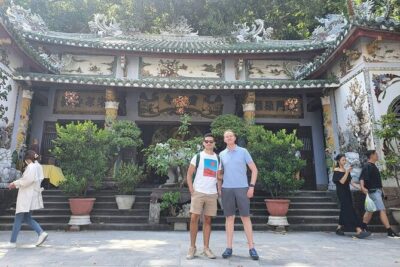
Marble Mountains are more than a scenic hill. They’re a working spiritual site with carved caves, pagoda architecture, and ongoing stonecraft nearby. Your day starts here, with time to explore the caves and the pagoda areas, plus the workshop-style atmosphere at the mountain’s base where artisans produce handmade sculptures.
You’ll also get the chance to ride up and enjoy panoramic views from Thuy Son, the only one of the five marble mountains accessible to visitors. That viewpoint matters because it turns Marble Mountains from a “pretty place” into a spot where you can actually see how the area sits relative to Da Nang and the coast.
Inside the complex, expect a mix of quiet corridors and religious spaces built during the Nguyễn Dynasty. The caves can feel mysterious in a good way, especially if you slow down and let the light and air settle as you move deeper in.
The craft stop is a smart add-on. It’s not just watching from far away—you get to meet artisans and see what goes into the sculptures made at the base. If you’re shopping, this is often where quality becomes obvious: you can ask questions, check details, and compare pieces while you’re already in the production zone.
What to watch for: you’ll be climbing and descending. Go with grippy shoes, and don’t count on smooth footing if it’s wet.
Cham Museum: your short, focused look at Cham culture
After Marble Mountains, the tour heads to the Da Nang Museum of Cham Sculpture, with about 30 minutes on the clock. That might sound short, but it’s enough time to orient yourself and get meaning from what you see rather than just moving past statues.
The museum is known for having the most complete collection of rare items of the Cham people. The payoff here is context: you start seeing how Cham art uses form and symbolism, and you understand that this region’s cultural story extends beyond what you can learn in beach-and-market time.
If you like museums but hate museum marathons, this is a good fit. The guide helps you focus on what to notice—materials, sculpture styles, and the general story the collection tells.
Drawback to consider: with only half an hour, you won’t get a slow, deep read of everything. If you’re the type who likes to linger in every room, you might want to come back to the museum later on your own time.
Lunch and travel comfort: what’s included, and what to plan for
Lunch is included, and it’s a fresh Vietnamese meal. This is one of those “small” inclusions that changes the whole day. Without lunch included, you’d lose time hunting for a decent spot, and you’d risk ending up somewhere touristy or inconvenient.
You can also request a vegetarian option when booking. So if you eat vegetarian most days, you’ll want to flag it ahead of time rather than trying to solve it at the table.
Alcohol isn’t included, so if you like a beer or a cold drink with lunch, budget for that separately. Tips also aren’t included, so decide in advance what feels fair for the guide and driver if the day goes well.
On the comfort side, the minivan helps you recharge between stops. The breaks between major sites—like the museum and lunch—matter because you’ll likely be walking on and off stairs for much of the morning.
If it rains, don’t panic. I’ve found that these routes can still run, but you should bring a light rain layer and keep an eye on slippery steps near the caves.
Wider sweeps of the old town and beyond




Son Tra Peninsula and the Thuan Phuoc Bridge engineering moment
After lunch, you head to Son Tra Peninsula. This is where the tour shifts from temples and museums into a more modern, scenic side of Da Nang.
The big headline is the ride over the Thuan Phuoc Bridge, described as the longest suspension bridge in Vietnam. Even if you’ve seen photos before, crossing it gives you that real sense of scale. It’s also a chance to appreciate how the city keeps building toward the water and how infrastructure shapes everyday life.
You’ll cross the lower Han River and get time in the area around Son Tra. The tour keeps this section efficient—about one hour—so it doesn’t eat your whole afternoon, but it still gives you space to step out for photos and look around.
One practical thought: bridges and viewpoints can be windy. Bring something light for your shoulders if you get cold easily, and keep your camera secure.
If you’re traveling with family or a mixed group, this stop often works because it’s less about climbing and more about taking in the view from relatively easy access areas.
Dragon Bridge, Han Market, and that last stretch of time
Before you head back to Hoi An, there’s time on the Da Nang side for a couple of quick hits: photo time by the Dragon Bridge and/or a stop at Han Market for shopping.
The Dragon Bridge is the symbol of Da Nang city, so even a short photo stop helps you put the city’s modern identity into context. And if shopping is on your agenda, Han Market is a convenient final chance to grab snacks, small gifts, or simple souvenirs without adding another half-day plan.
The shopping time is brief, so go in with a clear idea of what you want. If you’re hunting for specific items, consider setting a budget and spending limit before you arrive, since markets can be tempting and you’ll have limited time.
If you’re hoping for a lot of time inside Han Market, you might be slightly constrained here. The schedule favors sightseeing flow, not leisurely browsing.
Price and value: is $50 a fair deal?
At $50 per person, this tour lands in the “good value if you want structure” category. You’re paying for: a guide, an air-conditioned minivan, hotel pickup and drop-off, and a lunch that saves time. On top of that, you’re getting admissions at Marble Mountains and the Cham Museum included in the plan.
If you were to do this independently, you’d spend time arranging transport, timing tickets, and negotiating a day that crosses multiple areas of the city. The guide reduces that friction. The route also avoids the common problem of seeing one highlight well and missing the rest because you’re too tired to move.
Where the price doesn’t cover everything: alcohol and personal expenses are extra, and tips are not included. That’s normal, but it’s worth planning so the day doesn’t feel pricey at the end.
Booking-wise, the average lead time is about 10 days. If you’re traveling during peak season or on a busy weekday/weekend mix, it’s smart to lock it in earlier rather than waiting for last-minute availability.
What could go wrong: timing slips and stair strain
Here’s the honest part. This tour usually runs smoothly, especially because it starts with pickup and moves in a set order. Still, minivans can arrive late sometimes, and you’ll want to treat the morning as flexible rather than ultra-strict.
Language is another consideration. In places like this, some guides communicate perfectly well in English, but you might still encounter moments where they move ahead at their normal speed. If your Vietnamese is limited, plan to use a translation app and ask for clarifications early.
Physical comfort is the other variable: Marble Mountains can mean steady climbing. If you’re not used to stairs, take your time around the cave routes and pagoda areas. Bring water even if you think you can “just do without”—you’ll thank yourself later.
If you’re a group of mixed ability, this tour is generally manageable, but the pacing still affects everyone. Pick your spots for photos and viewpoints so you don’t feel rushed at the hardest part.
Who this tour is best for (and who should skip it)
This tour is a good match if you want to see Da Nang’s highlights from Hoi An without renting a scooter or coordinating multiple rides. It’s also ideal if you like guided context—especially at the Cham Museum—because it helps you make sense of what you’re seeing.
I’d especially recommend it if:
- You want a religion-and-culture morning and a modern-city bridge stop in the same day
- You value pickup/drop-off more than you value total freedom
- You’re traveling with limited time and want the best “one day” plan
You might want a different plan if:
- You dislike stair climbing or have mobility concerns
- You prefer slow museum time and long market browsing
- You’re the type who wants a fully independent schedule with no group pace
Should you book the Da Nang City Tour from Hoi An or Da Nang?
If your goal is a smart first look at Da Nang—Marble Mountains, Cham art, and a bridge-and-city ending—this tour is a strong choice for the price. The included lunch and admissions reduce decision fatigue, and the guided structure keeps you from wasting hours figuring out transit.
I’d book it if you’re okay with a group pace and some stairs. I’d reconsider if you need long, quiet time at each stop or if you’re very sensitive to schedule changes.
FAQ
How long is the Da Nang City Tour?
The tour lasts about 6 to 7 hours.
Where does the tour start, and is pickup included?
It’s based in Hoi An, and hotel pickup and drop-off are included from Hoi An or Da Nang.
What is the price per person?
The price is $50.00 per person.
Is lunch included?
Yes. The tour includes a fresh Vietnamese lunch.
Are admissions included for the main sites?
Yes. Marble Mountains (Ngu Hanh Son) and the Cham Museum include admission tickets. Other stops listed are free (no admission).
Can I request a vegetarian meal?
Yes. A vegetarian option is available if you advise the provider at booking.
What’s the group size?
The tour has a maximum of 20 travelers.
Is there a mobile ticket?
Yes. You’ll receive a mobile ticket.
Is alcohol included in the price?
No. Alcoholic drinks are not included and can be purchased separately. Tips are also not included.
What is the cancellation policy?
You can cancel for free up to 24 hours in advance for a full refund.
More Tours in Hoi An
- From Hoi An: Market Tour, Basket Boat Ride and Cooking Class
★ 4.8 · 2,208 reviews - Hoi An: Basket Boat with Lantern-Making & Cooking Class Tour
★ 4.9 · 1,444 reviews - Coconut Jungle Eco & Hoi An City Tour With Boat Ride
★ 5.0 · 800 reviews - Hoi An: Ancient Town Guided Walking Tour
★ 4.9 · 766 reviews - Hai Van Pass Motorbike Private Tour with Mister T Easy Rider
★ 5.0 · 742 reviews - Hoi An Countryside: Guided Morning or Afternoon Bicycle Tour
★ 4.9 · 686 reviews
More Tour Reviews in Hoi An
- Hoi An: Basket Boat Ride in the Coconut Forest
★ 4.9 · 4,956 reviews - Hoi An: Vietnamese Coffee Culture and Coffee Making Class
★ 4.9 · 4,006 reviews - Hoi An: Vietnamese Foldable Lantern Making Class
★ 4.9 · 3,742 reviews - Cooking Class Hoi An:Local Market, Basket Boat, Fishing & Cooking
★ 5.0 · 3,660 reviews - Hoi An Cooking Class(Market,BasketBoat Crabfishing&Cooking Class)
★ 5.0 · 3,386 reviews - Hoi An: My Son Sanctuary Early Morning w. Champa Food Brunch
★ 4.9 · 2,750 reviews
Up the Coast to Da Nang
- Hoi An/ Da Nang – Ba Na Hills – Golden Bridge Deluxe Small group
★ 5.0 · 2,613 reviews - Da Nang/Hoi An: Hue Imperial City via Hai Van Pass & Lunch
★ 4.7 · 753 reviews - Hoi An/Da Nang: Golden Bridge , My Son Sanctuary & Marble Mt
★ 5.0 · 725 reviews - Hoi An/Da Nang: Vietnamese Cooking Class with Transportation
★ 4.9 · 297 reviews - Hoi An/Da Nang Ba Na Hills – Golden Bridge small group
★ 5.0 · 274 reviews - Da Nang/Hoi An: Market Tour, Basket Boat Ride, Cooking Class
★ 4.7 · 253 reviews
Just Reviewed: Fresh Hoi An Trips



Da Nang Day Trips, compared.
 ★ 5.0Hoi An/ Da Nang – Ba Na Hills – Golden Bridge Deluxe Small groupFrom $212,613 reviews
 ★ 4.7Hue Imperial City via Hai Van Pass & LunchFrom $9753 reviews
 ★ 5.0Golden Bridge , My Son Sanctuary & Marble MtFrom $15725 reviews
 ★ 4.9Vietnamese Cooking Class with TransportationFrom $22297 reviews
 ★ 5.0Hoi An/Da Nang Ba Na Hills – Golden Bridge small groupFrom $99274 reviews
 ★ 4.7Market Tour, Basket Boat Ride, Cooking ClassFrom $18253 reviews
 ★ 5.0My Son Sanctuary and cruise trip from Hoi An/ Da NangFrom $19229 reviews
 ★ 5.0Hoi An/Da Nang guided tour to BANA HILLS with Cham Cham TravelFrom $49220 reviews
Browse the lists this tour appears in